

Why We Struggle To Accept Compliments. My first reaction to someone saying these words to me would be, “What?! Who? Me?!”. I’m not sure why, but I often find it surprising when someone compliments me. And more often than not, I feel ill at ease, and self-conscious.
I NEVER LET IT SINK IN when I receive a compliment with a “thank you.” I shrugged and went on with whatever was happening at the moment. This can seem quite strange that so many of us crave compliments as validation, but we never fully accept them.
I can’t help but wonder why we can be so quick to believe negative things and have a hard time accepting compliments.
We are bombarded with incentives to be better, but compliments tell us we are enough just as we are. And for a lot of us, this is not easy to believe. Why?
Table of Contents
Why Is It Hard To Accept or Receive Compliments
It is hard to accept compliments primarily due to cognitive dissonance a psychological conflict where positive praise contradicts a person’s low self-esteem or negative self-image. Other factors include imposter syndrome, a fear of high future expectations, and cultural conditioning that equates accepting praise with arrogance.
Also peoples have difficulty accepting compliments because it can be hard to quantify or contextualize the excellent feeling. Several things make it hard for me to believe and fully accept compliments.
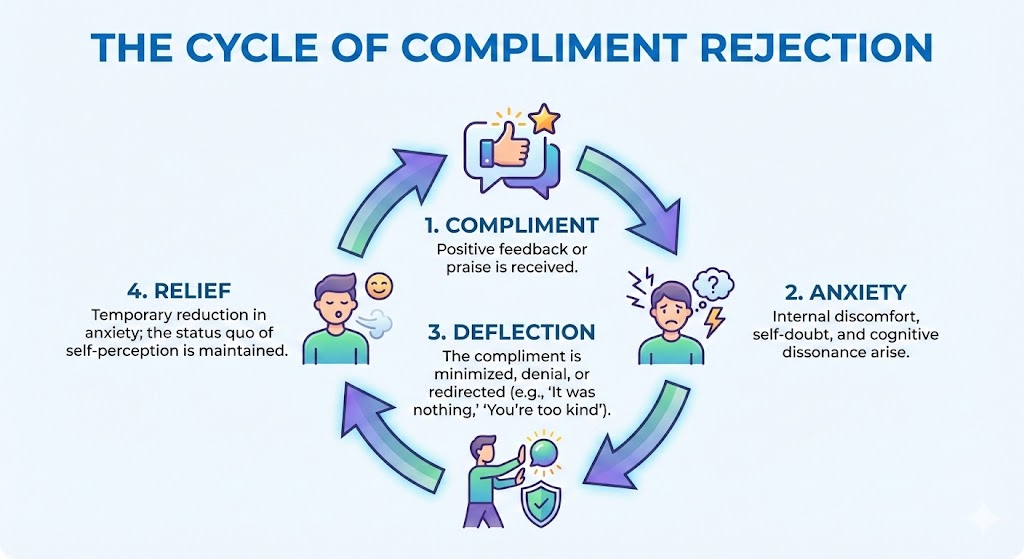
Reasons Why Accepting Compliments Is Difficult
Common psychological reasons for rejecting compliments include:
- Low Self-Esteem: Disbelief that the praise is true.
- Cognitive Dissonance: Mental stress when words contradict self-view.
- Fear of Expectations: Worry that you cannot repeat the success.
- Trust Issues: Suspecting the complimenter has ulterior motives.
- Social Anxiety: Fear of drawing attention to oneself.
The Psychology Cognitive Dissonance
Psychologists attribute this discomfort to a phenomenon called Cognitive Dissonance. This occurs when a compliment contradicts your existing self-belief. If you view yourself as ‘flawed’ or ‘unworthy,’ and someone calls you ‘talented’ or ‘beautiful,’ your brain detects a conflict. To resolve this mental tension, your mind instinctively tries to reject the new information (the compliment) to preserve your established self-view. This is why praise can physically feel like a lie it clashes with your internal reality.
You don’t know me
Like most of us, I believe I know myself pretty well.
Even if it is not true (we don’t know ourselves that well, and others know us better than we think!), I still believe that they wouldn’t say these nice things If they only knew how well I know myself.
I know I am not “insert whatever compliments you hear,” so people who say this are most probably wrong.
That is a shame, but we tend to dismiss things that do not align with how we see ourselves.
In the same line of thought, I can find it difficult to love myself as I am, and it feels a bit strange that others do and say so.
For people with low self-esteem, compliments can be a source of discomfort. And sometimes, it is for me.
This is not a valuable piece of information.
I don’t know about you, but I do value other people’s opinions, and I take criticism as valuable information on my way to being a better person.
When it comes to compliments, on the other hand… Well, I don’t consider it a valuable piece of information because, you know, it means I am fine, something is good in me.
If there is no work to do about this thing, why talk about it, right?
I don’t want to be presumptuous.
If I accept a compliment, I may be afraid people will think I am arrogant, so it is better to just discard it.
I don’t want to act like I know how beautiful a human I am, right? It would be presumptuous and maybe make other people uncomfortable.
The Politeness Double Bind
Cultural conditioning also plays a massive role. Many of us are raised to believe that humility is a virtue and agreeing with praise is arrogance. This creates a ‘Politeness Double Bind’: if you agree with the compliment (‘Yes, I did do a great job!’), you risk seeming conceited. If you deflect it (‘Oh, it was nothing’), you dismiss the giver. The middle ground graceful acceptance is a skill that bypasses this trap by focusing on gratitude rather than agreement.
How to accept compliments humbly?
Instead of overthinking, rely on these three pre-planned scripts to navigate the moment gracefully:
- The Simple Acceptance: “Thank you, I really appreciate that.”
- The Team Acknowledgment: “Thank you, the whole team worked hard on this project.”
- The Vulnerable Truth: “Thank you. It’s hard for me to hear that, but I appreciate you saying it.”
Remember, accepting a compliment isn’t about agreeing that you are perfect; it’s about acknowledging the other person’s kindness.
When someone compliments you, it’s essential to be humble. Most people are just trying to help and are not looking to judge you. You must show that you appreciate the compliment and take it in stride.
Better be (or look) humble…
I have learned that letting yourself shine allows others to shine (there is a beautiful quote from Marianne Williamson about it!).
My head knows but not my heart.
Lastly, I try to acknowledge the beautiful human I am. In that process (it is long and arduous work), I can recognize I am intelligent and funny, pretty, and many other great things.
I mean, my head kind of knows it. But it never goes deeper than me trying to convince me.
It is challenging to know in your heart that these things are true. Many other things can make it difficult to fully accept a compliment.
Maybe you think people are just flattering, you don’t feel you are worthy of it (even if YOU ARE!), or you are convinced you are never good enough (even if YOU ARE!)…. So what can we do?
Spend the rest of our lives wriggling on our chairs every time we hear what remotely sounds like a compliment? Hopefully, not.
What can we do? Pay attention!
Sometimes, a compliment touches you more than usual. Because it comes from someone new, or you are in a different mood, or maybe because you needed to hear this, even if you didn’t know it. The fact is, it resonates with you.
I had one of these moments a few months ago, and it changed something in me. Hence, this article.
I felt seen unusually; the words seemed to make sense in a way they didn’t before, and I made them mine for a while. Then I reverted to my old habits. But I tried to have another perspective.
I started paying more attention to compliments.
When someone compliments me, my head tells me it’s not true.
I want to be able to believe compliments, to make them mine. So I pause for a moment. I listen to what has been told. I take a breath. And I do the only thing I can do; I say yes to what is. I say yes to the compliment. I say thank you for it.
And even if my heart doesn’t always believe it, I know my head isn’t the only one controlling what is right and what is not. It is hard to make a compliment mine, but it is worth working on accepting them.
Conclusion
In the end, I think we can only start to accept compliments from others when we begin believing for ourselves we are worthy of them. Compliments are just a friendly reminder of who we are. A reminder we are enough, and we are good enough.
FAQs
Is it normal to feel uncomfortable receiving compliments?
Yes, it is common. This discomfort often stems from a psychological conflict known as cognitive dissonance, where the praise contradicts your internal self-image.
What is the best way to respond to a compliment?
The best response is a simple ‘Thank you.’ Avoid deflecting or self-deprecating. You can add ‘I appreciate you noticing’ to acknowledge the giver’s kindness.

- Top Group Camping Activities to Enhance Your Outdoor Experience - February 26, 2026
- How Modern Orthodontics Is Changing Smiles for All Ages - February 26, 2026
- How Personalized Weight Loss Plans Are Transforming Lives - February 26, 2026