
Table of Contents
Key Takeaways:
- R.T. Laird, Inc. offers shock-absorbing casters designed to reduce the effects of rolling shock and vibration.
- The company reports reductions of up to 80% in shock and vibration, plus noise reductions of up to 25 decibels, depending on the application.
- Floor condition, load, travel speed, wheel size, mounting configuration, and operating environment all affect real-world results.
- A detailed application review helps match caster performance to equipment, payload, and travel-route requirements.
- Quieter casters can support a broader strategy for payload protection, equipment care, floor preservation, and operator comfort.
Rolling carts, equipment frames, fixtures, and sensitive loads can create disruptive noise when wheels strike seams, thresholds, uneven concrete, or metal transitions. A properly selected noise reducing caster from R.T. Laird, Inc. can help limit the shock, vibration, bounce, and impact noise associated with routine equipment movement.
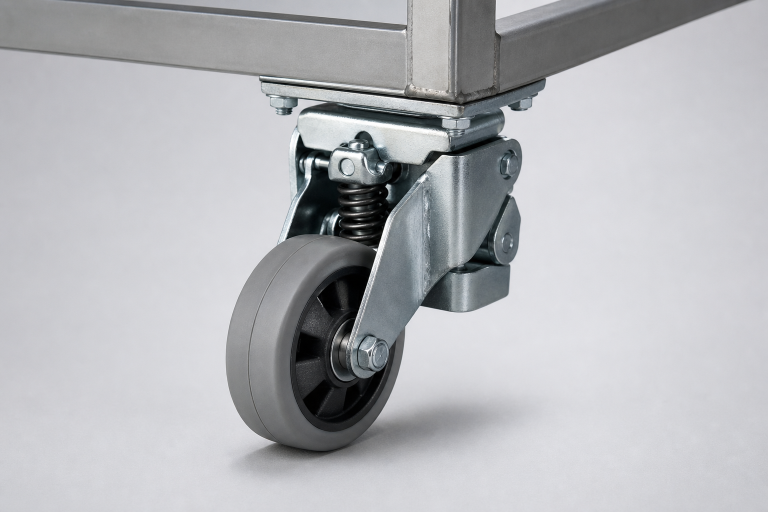
R.T. Laird, Inc. specializes in spring-loaded, shock-absorbing caster designs for applications where smoother transport matters. Rather than treating wheel noise as an unavoidable part of material handling, facility teams can evaluate the caster, load, travel route, and mounting arrangement as a system.
Why Caster Noise and Vibration Matter
Noise from moving equipment is not only an annoyance. Repeated impacts can transmit energy through the cart frame and into the payload, which may contribute to unstable movement, jarring operator feedback, wheel wear, or damage to sensitive components. In busy manufacturing, warehousing, aviation, food service, and technology environments, rolling noise can also make nearby communication more difficult.
Workplace noise deserves attention as part of an overall safety program. CDC data indicate that about 28% of U.S. workers have experienced hazardous noise exposure, and 53% of noise-exposed workers report not wearing hearing protection. Those figures provide useful context for reducing avoidable noise sources wherever practical.
What Makes R.T. Laird, Inc. Casters Different?
Conventional caster designs can transfer a sharp impact to the equipment when a wheel encounters a floor joint, debris, or an uneven surface. R.T. Laird, Inc. describes its shock-isolating models as using a broad deflection range and a more gradual spring response. The purpose is to help absorb a portion of the impact before it reaches the cart, vehicle, or payload.
In practical terms, that controlled movement can help reduce shimmy, dynamic bounce, resonance, and abrupt vibration. R.T. Laird, Inc. also states that its shock-isolating designs can reduce these effects under loads at least 50% greater than rated capacity. Selection should still be reviewed against the actual equipment, operating conditions, and mounting requirements, rather than on load rating alone.
Problems a Shock-Absorbing Caster Can Help Address
- Sharp noise at floor transitions: Suspension movement can help soften the wheel impact caused by seams, thresholds, and expansion joints.
- Vibration affecting fragile loads: Shock isolation may help reduce the amount of jarring motion transferred into transported components or instruments.
- Cart bounce or shimmy: A gradual spring response can support steadier movement over imperfect surfaces.
- Premature wheel wear: Reducing repeated impacts may lessen stress on wheels and related components.
- Potential floor and equipment damage: Lower-impact rolling behavior may help reduce harsh contact forces at the wheel and frame.
Where R.T. Laird, Inc. Casters Can Be Used
Shock-absorbing casters are useful wherever equipment is moved frequently, and route conditions are less than ideal. Common applications include manufacturing carts and production fixtures, material-handling equipment, aviation and aerospace support equipment, food-service carts, computer and technology equipment, and specialized transport systems for delicate or high-value loads.
Each setting presents different challenges. A heavy fixture traveling over concrete may require a different configuration than a cart carrying electronic hardware, a mobile food-service unit, or equipment moving through a facility with ramps, grating, washdown areas, or frequent thresholds.
How to Select the Right Caster for the Application
The best starting point is to document the operating conditions before requesting a recommendation. Load capacity matters, but it is only one part of the selection process.
Information to Gather Before Requesting a Quote
- Record the total loaded weight, including the cart, payload, accessories, and mounted equipment.
- Estimate the load carried by each caster during normal travel and while crossing transitions.
- Measure wheel diameter, mounting dimensions, available clearance, and required swivel or rigid positions.
- Describe the floor surfaces, including concrete, ramps, seams, grating, thresholds, outdoor pavement, and debris.
- Identify typical travel speed, distance, frequency of use, and whether movement is manual or powered.
- Explain the main priority, such as lower noise, less vibration, payload stability, floor protection, or reduced wheel wear.
- Include environmental conditions such as moisture, chemicals, washdown exposure, temperature, and contamination.
How Casters Fit Into a Workplace Noise-Control Strategy
Caster selection can be an engineering control at the source of rolling noise, but it is not a substitute for evaluating the full facility sound profile. Equipment maintenance, route improvements, layout changes, noise monitoring, administrative controls, and hearing protection may all be appropriate depending on the work environment.
OSHA explains that engineering controls reduce noise at the source, along the transmission path, or at the worker’s location. For a noisy cart route, this can mean evaluating both the caster system and the surfaces the equipment most often crosses.
How to Evaluate Results After Installation
Compare performance before and after installation under the same conditions. Use the same load, route, travel speed, and sound-level meter location where possible. Document wheel noise at common transitions, payload movement, operator feedback, cart stability, and visible wear on wheels, mounting hardware, and suspension components.
R.T. Laird, Inc.’s reported reductions are useful performance benchmarks, not universal guarantees. Actual noise and vibration results will vary with the equipment design, load distribution, wheel material, route condition, maintenance practices, and operating environment.
Conclusion
R.T. Laird, Inc. provides a focused solution for organizations seeking to reduce noise, shock, and vibration caused by moving equipment. By reviewing the complete application rather than relying on a basic load rating, buyers can select caster systems that enable quieter movement, better payload control, and more durable material-handling operations.

- How Jacksonville, Florida Homeowners Can Spot Hidden Plumbing Leaks Before Damage Spreads - September 15, 2026
- How to Reduce Workplace Noise and Vibration With R.T. Laird, Inc. Casters - September 15, 2026
- Find Chicago Souvenir Gifts Faster With SouvenirCityChicago - August 29, 2026