
Banking litigation routinely involves highly nuanced financial matters, often posing significant comprehension challenges for judges and juries unfamiliar with the complexities of financial institutions. Expert testimony has become indispensable in these cases, providing clarity on critical issues such as complex transactions, regulatory requirements, and the nuances of market behavior. An experienced bank expert witness can help translate the intricacies of banking practice into language the court can understand, thereby shaping—not just explaining—the direction of a case.
Professional insights provided by banking experts bridge the gap between specialized financial knowledge and legal reasoning, offering not just facts but also evaluations grounded in industry standards. Their contributions often help determine liability, quantify damages, and provide context on prevailing banking practices, making their role central to both plaintiff and defense strategies.
As courtrooms increasingly confront financial innovations and evolving regulations, the expertise and credibility brought by such witnesses become ever more vital. Detailed and persuasive testimony can be the distinguishing factor that sways verdicts, especially in cases where the technical aspects are pivotal to the dispute.
Moreover, because banking litigation often involves multiple parties, cross-border transactions, and regulatory scrutiny, having a trusted expert to break down these layers enhances transparency and fosters a more informed judicial process.
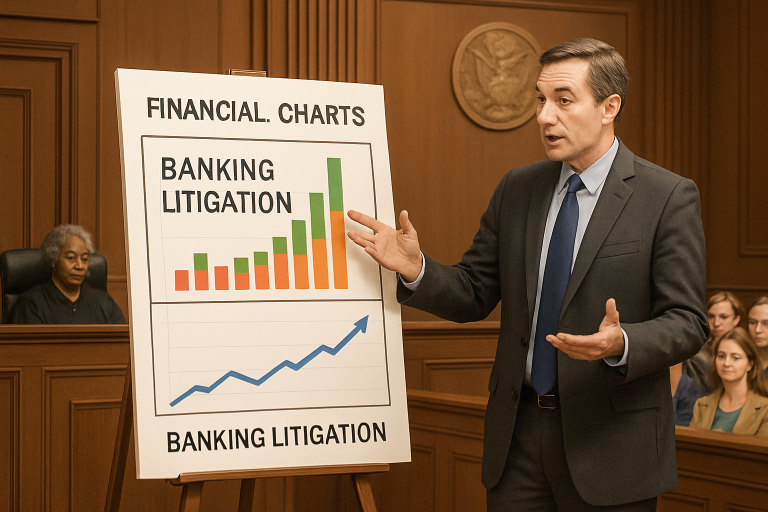
Table of Contents
Key Takeaways
- Expert witnesses play a crucial role in simplifying complex banking and financial concepts for courts.
- Credibility and proper methodology are crucial for expert witness testimonies to be persuasive and admissible.
- Recent changes in legal standards, such as amendments to Federal Rule 702, emphasize the importance of reliability in expert testimony.
The Role of Expert Witnesses in Banking Litigation
Expert witnesses are called upon for their in-depth understanding of banking operations, lending standards, forensic accounting, and risk management, among other areas. Their declarations and testimony help courts reach fair decisions in disputes over matters like fraudulent transactions, breach of fiduciary duty, and regulatory compliance.
They serve several functions:
- Clarifying complex concepts: Experts can articulate banking procedures and market practices in accessible ways.
- Interpreting financial documentation: From loan agreements to internal audit reports, experts shed light on what key documents indicate in the context of industry norms.
- Assessing damages: Courts may rely on expert witnesses to establish the extent and cause of financial losses, evaluate asset values, or determine the impact of specific actions or omissions.
- Advising on regulatory frameworks: Since banking is highly regulated, experts assist the court in understanding applicable state, federal, and sometimes international regulations.
In cases where allegations hinge on technical details, such as alleged violations of anti-money laundering protocols or improper lending practices, experts become indispensable by providing context and clarification. Their reasoned explanations help reduce ambiguity and prevent misunderstandings that could obscure the facts of the case.
Enhancing Credibility and Persuasion
The impact of an expert’s testimony extends beyond the factual information provided; it also encompasses the expert’s credibility, authority, and communication skills. Credible expert witnesses lend substantial weight to a party’s arguments by validating key claims and offering independent, objective analysis in contested areas. According to resources from the American Bar Association, the persuasiveness of expert testimony is amplified when it is founded on sound methodologies and aligned with widely accepted industry practices.
Effective expert testimony can capably counter opposing opinions, dismantle weak arguments, and provide a clear, logical pathway for the court to follow. The expert’s ability to clearly articulate complex topics has been proven to influence both the judge’s and jury’s perceptions, thereby shaping the outcome of banking litigation in fundamental ways.
Recent Changes Impacting Admissibility of Expert Testimony
The admissibility of expert witness testimony is not static; it evolves in tandem with changes in legal standards and evidentiary requirements. Notably, amendments to Federal Rule 702 now require that expert opinions admitted in federal court must not only be relevant, but also reliably grounded in sufficient data and appropriate analytic methods. This renewed focus on ensuring the scientific and technical reliability of testimony means that experts must meticulously document the data and methodologies behind their opinions.
The heightened standards place an increased onus on attorneys and their expert witnesses to rigorously vet and prepare reports, and to anticipate challenges on both methodological and substantive grounds. Courts are more attentive than ever to the potential for speculative or unsupported opinions, resulting in a more disciplined and robust process for admitting expert testimony in banking litigation.
Challenges in Expert Testimony
Despite their value, expert testimonies are frequently scrutinized. Testimony that appears excessively speculative, lacks rigorous methodological backing, or is not anchored in actual industry standards risks being excluded by the court. Opposing counsel often employ Daubert motions or similar procedural tools to challenge the qualification, methodology, or relevance of an expert’s opinions. Consequently, preparation, documentation, and the expert’s ability to defend their findings under cross-examination are critical factors for success in banking litigation.
Effective expert witnesses must not only possess relevant qualifications but also have the experience and composure necessary to explain and defend their methodologies before the court. Failure to do so may undermine the weight of their testimony or lead to outright exclusion, ultimately weakening the case.
Final Thoughts
Expert testimony is a cornerstone of modern banking litigation, providing much-needed clarity and reliability in disputes characterized by financial complexity and high stakes. With ongoing changes to admissibility standards highlighting the importance of strong methodological foundations, the careful selection and preparation of expert witnesses have never been more critical. As illustrated by recent cases and current legal frameworks, the influence of expert testimony extends well beyond technical explanation—it can be the difference between success and failure in the courtroom.

- How Expert Testimony Can Influence Banking Litigation Outcomes - January 16, 2026
- Divorce Annulments Demystified: Facts, Misconceptions, and What to Know - December 8, 2025
- Setting Healthy Boundaries for Better Mental Wellness - November 20, 2025