
Today, the relationship between science and faith is more nuanced and dynamic than ever. As scientific discoveries push the boundaries of what we know about the cosmos, faith communities actively engage with these new realities. Discussions about how the universe began, why it is fine-tuned for life, and how consciousness arises spark vibrant debate and contemplation. For those exploring these questions, resources like Heaven Lights A Christian Paradigm ebook offer thoughtful insight into bridging scientific and theological perspectives.
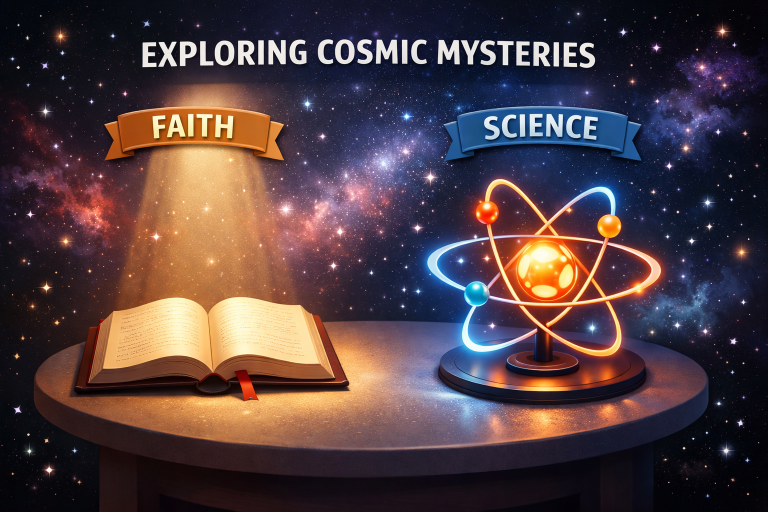
Modern faith traditions do not exist in isolation from scientific insights. Many theologians and scientists view science and spirituality as complementary rather than contradictory. Where once these fields seemed mutually exclusive, there is now a significant movement towards respectful dialogue and integration.
Scientific models of the universe often spark new philosophical and theological discussions. Some see scientific explanations as mutually supportive of theistic beliefs, while others see them as challenging traditional doctrine. These ongoing conversations invite people of faith to reconsider and deepen their understanding of creation and existence.
It is precisely in this dialogic space that both science and faith are enriched. The interplay between these perspectives encourages open-minded exploration, leading to a more holistic outlook on the mysteries of the universe and our place within it.
Table of Contents
Historical Context: Science and Faith
Throughout history, the relationship between science and faith has shifted dramatically. During the Scientific Revolution, thinkers such as Galileo Galilei and Isaac Newton perceived their scientific endeavors as deepening their reverence for divine creation. Over time, however, as scientific understanding expanded to fill many gaps once occupied by religious explanations, some began to view science and faith as mutually exclusive. These historical developments laid the foundation for contemporary dialogue about whether belief in God is compatible with a scientific worldview. Recent perspectives advocate a more unified approach, seeing both science and faith as partners in the search for truth. For a historical overview, see Encyclopedia Britannica’s take on science and religion.
Cosmology and Creation Narratives
The Big Bang theory and other models of the universe’s origin have sparked intense debate over their implications for faith. Some religious traditions interpret scientific cosmology as evidence of a creator who set the cosmos in motion. Conversely, others experience tension between literal interpretations of sacred texts and current scientific theories. Interfaith and interdisciplinary dialogues continue to examine how cosmological insights complement or challenge spiritual narratives of creation, allowing for both metaphorical and literal readings of ancient texts.
Fine-Tuning and the Anthropic Principle
Physical constants in the universe are so precisely calibrated for the existence of life that some argue this “fine-tuning” strongly suggests purpose or design. The anthropic principle reflects on how we, as observers, perceive the universe in ways that enable our existence. Some interpret these observations as hints of a divine creator, while others point to emerging multiverse theories, suggesting that many universes may exist under different conditions. This ongoing debate sits at the intersection of metaphysics, science, and theology, inviting deep questions about meaning and chance.
Evolution and Divine Action
Evolution has profoundly influenced modern theology. Many religious scholars now view evolutionary processes as expressions of divine creativity, rather than threats to faith. The concept of “theistic evolution” holds that God works through the natural laws and processes described by science. This view aims to harmonize scientific accounts of human origins with spiritual understandings of purpose and meaning. For an insightful overview of this perspective, see the National Geographic report on evolution and faith.
Quantum Mechanics and Theology
Quantum mechanics has upended many assumptions about determinism and causality. Some theologians posit that the inherent uncertainty in quantum events provides a space for divine action, without violating natural laws. Philosophical questions about free will, fate, and providence are rejuvenated by discoveries in physics, showing how religion and science can mutually inform each other’s understanding of how God might interact with creation.
Consciousness and the Soul
Advances in neuroscience challenge and also enrich traditional conceptions of the soul. The exploration of consciousness, personal identity, and the possibility of life after death has become a key intersection for philosophical inquiry. While scientific investigation uncovers more about brain function, theological perspectives ask whether consciousness can be fully explained by material processes or if an immaterial essence persists beyond physical death. This ongoing conversation bridges fields and encourages a deeper appreciation of human experience.
Ethical Implications of Scientific Advancements
Rapid technological advancements in areas such as genetics, artificial intelligence, and biotechnology raise profound ethical questions. Gene editing, cloning, and AI development challenge traditional religious beliefs about the sanctity of life, human dignity, and the limits of human intervention. Faith-based moral frameworks remain vital for guiding responsible innovation and addressing contentious bioethical dilemmas.
Conclusion
The interplay between scientific insight and modern faith shapes a more comprehensive understanding of the universe and our role within it. By engaging with scientific discoveries, religious traditions can offer meaningful responses to contemporary existential questions, while science benefits from the ethical frameworks offered by faith. Ultimately, the dialogue between science and faith enriches not only belief but also the pursuit of knowledge and meaning, offering a deeper connection to the mysteries that surround us.

- Buyer’s Checklist for Desert-Smart Luxury Homes in Las Vegas, Nevada - October 12, 2026
- How to Create a Safer Pool Area in Orange County, California - October 12, 2026
- Scorecard for Choosing a Queen Creek, Arizona Neighborhood - September 25, 2026